The Major Arcana
The Major Arcana are the 22 trump cards of the tarot, from zero (The Fool) to XXI (The World). DESNAVO reads them in its own Folio of Trumps: names and order follow the historical Marseille pattern, each card has its own drawing made for the app and is read for its light and its shadow.
Where the cards come from
Tarot cards are documented in fifteenth-century northern Italy as playing cards for a trick-taking game; the trumps were an additional picture series. The Marseille pattern spread in the seventeenth and eighteenth centuries. Only in the late eighteenth century did French writers read the game occultly; the nineteenth century brought cartomancy and systems such as the Golden Dawn's, which swapped Justice and Strength. Many meanings familiar today date from this late period.
0 · The Fool
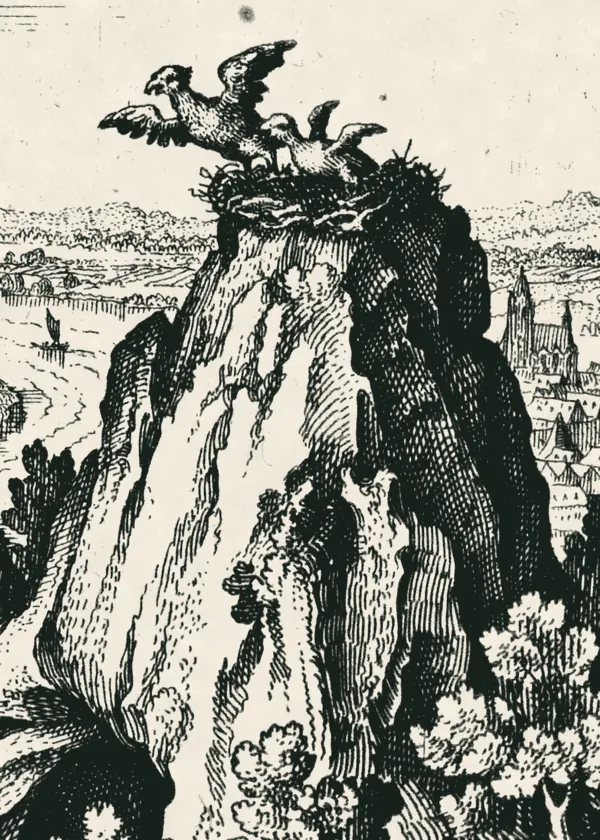
Keywords: Setting out · trust · openness
The Fool stands at the edge, not knowing where the next step leads — and walks anyway. The engraving from Michael Maier's “Atalanta fugiens” (1618, Emblem VII) shows a fledgling on a steep rock spreading its wings for its first flight: nothing is fixed yet, everything is possible. In cartomancy since the nineteenth century he is the zero before all numbers, the beginning before any plan. He reminds you that aliveness often starts where you cannot secure everything. His wisdom is not naivety but trust: in the path, in your alertness along the way, and in what you only learn by walking.
Origins and symbolism
Unnumbered in Marseille decks (“Le Mat”); in the Italian game a special card outside the run of trumps. Later cartomancy read it as setting out and unguardedness.
The card image: Emblem VII: the fledgling leaves the nest (Michael Maier (text); engravings attributed to Matthäus Merian the Elder, 1618). A fledgling risks its first flight from the rock – setting out without knowing everything yet.
Question: Where would I like to try something for the first time without knowing everything yet?
Step for today: Do one small thing deliberately differently today — a new route, a new question.
I · The Magician
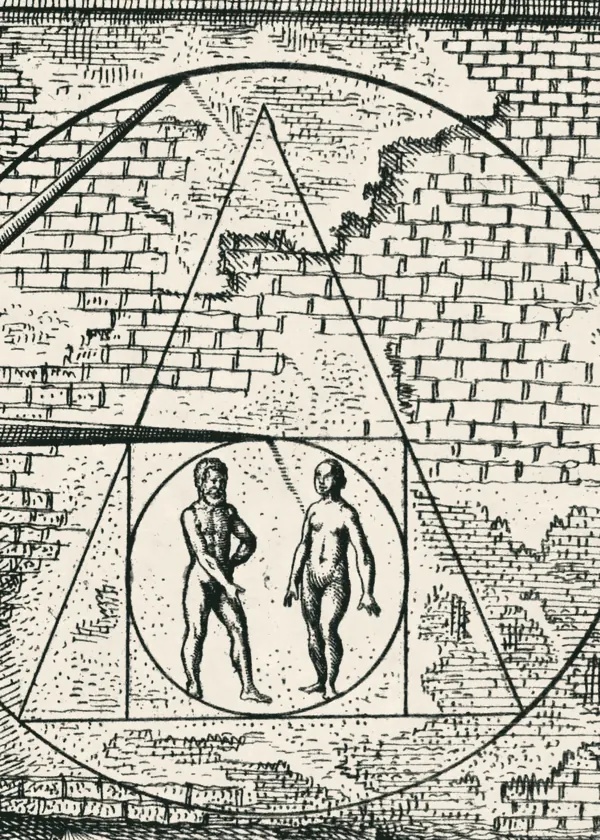
Keywords: Skill · focus · initiative
The Magician has everything he needs in front of him: the engraving from Maier's “Atalanta fugiens” (1618, Emblem XXI) shows a pair of compasses drawing circle, square and triangle around a man and a woman — geometry as a tool for ordering what is already there. Originally he was a street performer with cups and balls; nineteenth-century occult writers turned him into the magus who orders the four elements. Both readings meet in one question: what can you bring about with what is already there? The card speaks of gathered attention, of skill and of the moment an idea gets hands. It invites you not to wait for better circumstances.
Origins and symbolism
“Le Bateleur” was originally a street conjuror with cups and balls. Nineteenth-century occult writers recast him as the magician holding the four elements.
The card image: Emblem XXI: circle, square and triangle (Michael Maier (text); engravings attributed to Matthäus Merian the Elder, 1618). A scholar draws circle, square and triangle with compasses – using the means at hand deliberately.
Question: Which means are already on my table that I am not using yet?
Step for today: Set out three things you need for a project and start with the first one.
II · The High Priestess
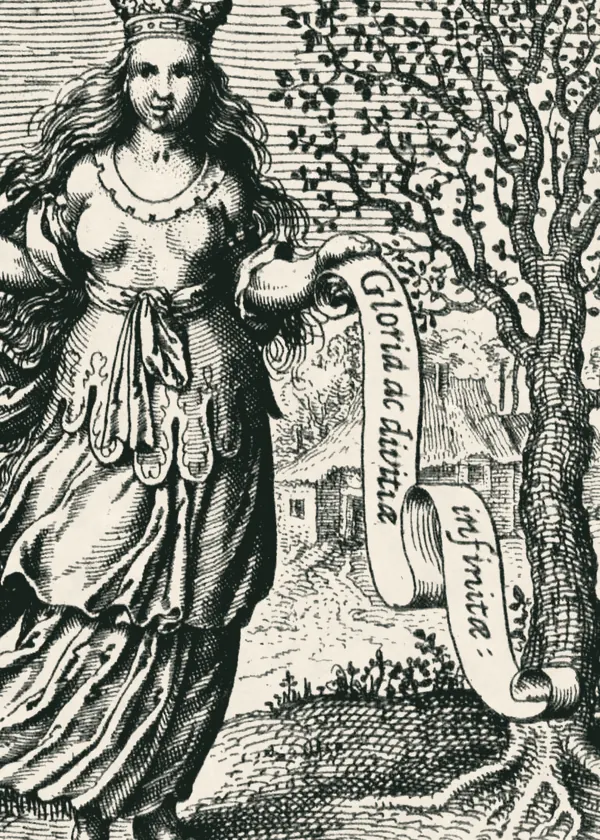
Keywords: Intuition · stillness · hidden knowledge
The High Priestess sits between two pillars, before a veil behind which lies something that does not yet want to be said. In the Marseille image she holds a book; the Golden Dawn called her High Priestess and linked her with the Moon. This card shows, from Maier's “Atalanta fugiens” (1618, Emblem XXVI), crowned Wisdom with a scroll beside the tree of life. She is the card of pausing: not everything has to be explained, decided or shared at once. She invites you to trust your perception before you have proof, and to listen to dreams, hunches and the signals of your body. Her power is receptive — she waits until a knowing is ripe enough to be spoken.
Origins and symbolism
In the Marseille image “La Papesse” holding a book. The Golden Dawn tradition around 1900 called her High Priestess and linked her with the Moon and hidden knowledge.
The card image: Emblem XXVI: Wisdom and the tree of life (Michael Maier (text); engravings attributed to Matthäus Merian the Elder, 1618). Wisdom with a scroll beside the tree of life – quiet knowledge not yet spoken.
Question: What do I already know quietly, before I can say it out loud?
Step for today: Write down one sentence you have only thought so far and leave it until tomorrow.
III · The Empress
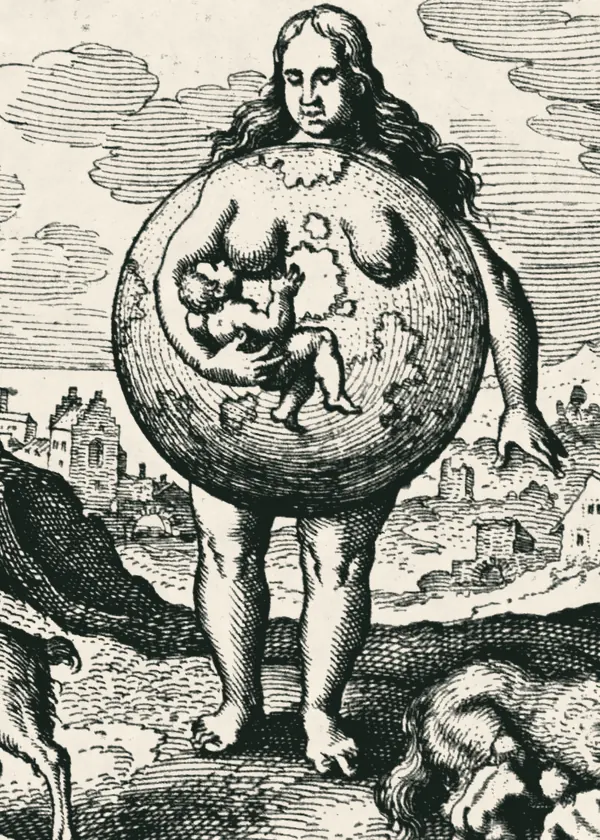
Keywords: Abundance · care · growth
The Empress rules not by pressure but by growth. The engraving from Maier's “Atalanta fugiens” (1618, Emblem II) shows the Earth as a woman whose body is a globe, with a child drinking at her breast — “the earth is its nurse”. In cartomancy she is the card of abundance, sensuality and creative care — everything that thrives when it is given time, warmth and attention. She asks what wants to grow in your life and how you can nourish it without pulling at it. Her wealth is not possession but aliveness: a garden, a relationship, a work that ripens with you.
Origins and symbolism
“L’Impératrice” with scepter and shield. Later readings linked her with abundance, care and growth.
The card image: Emblem II: the Earth is its nurse (Michael Maier (text); engravings attributed to Matthäus Merian the Elder, 1618). The Earth nurses a child at her breast – abundance, care and growth.
Question: What is growing for me right now if I leave it alone and tend it?
Step for today: Spend ten minutes caring for something alive: a plant, a meal, a friendship.
IV · The Emperor
Keywords: Order · responsibility · clarity
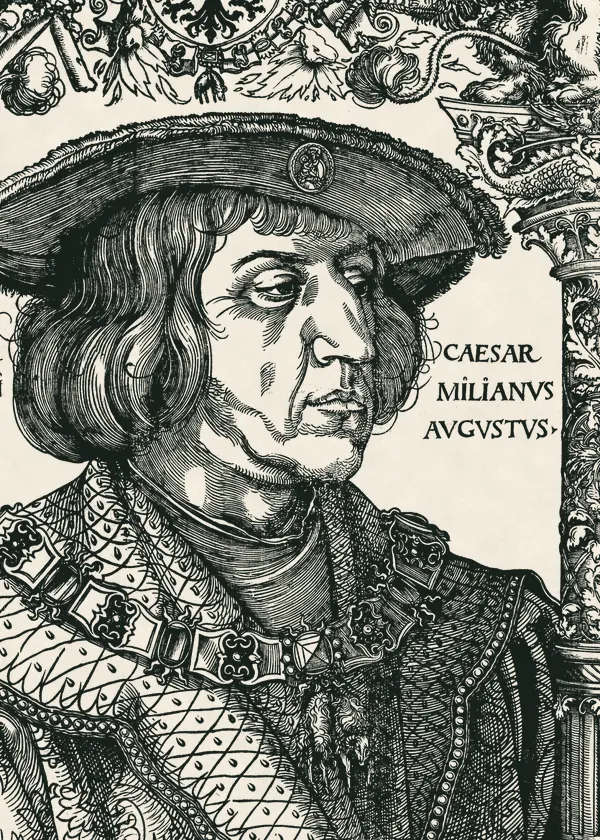
The Emperor sits firmly on his throne. The card shows Hans Weiditz's woodcut portrait of Emperor Maximilian I (1519): a grave gaze, a broad hat, the chain of an order on his chest and beside him the title “Caesar Maximilianus Augustus”. Cartomancy reads him as order, structure and responsibility — the strength to secure a space in which life can unfold. After the flowing abundance of the Empress he brings form: rules, boundaries, decisions. He asks where you may take responsibility and which structure carries you rather than confines you. His authority is strongest when it protects rather than dominates.
Origins and symbolism
“L’Empereur” with an eagle shield. Cartomancy read him as order, structure and responsibility.
The card image: Portrait of Emperor Maximilian I (Hans Weiditz the Younger, 1519). The emperor in half-length with his titles – order, office and responsibility.
Question: Which structure would give me freedom right now rather than take it away?
Step for today: Fix a set time tomorrow for one thing that matters to you.
V · The Hierophant
Keywords: Teaching · tradition · community
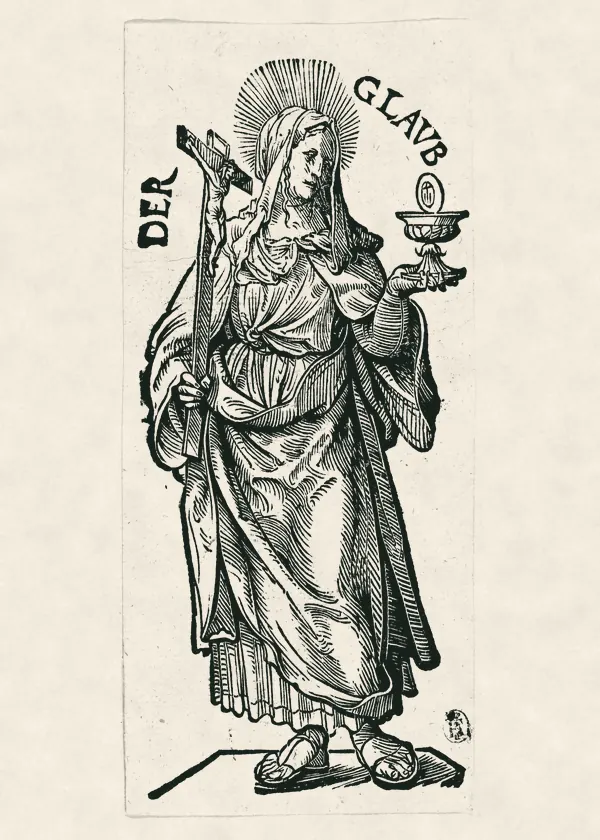
The Pope — the Hierophant in English decks — stands for what is passed on. The card shows “Faith” from Hans Burgkmair's woodcut series of the seven virtues (c. 1510): a haloed figure with cross staff and chalice — tradition handed on. In the Marseille pattern he blesses two figures; readings speak of teaching, tradition and belonging. He asks which sources you draw from and which teachers you trust. He reminds you that no one grows wise alone: knowledge grows in conversation, in ritual, in community. At the same time he invites you to test what is handed down against your own experience.
Origins and symbolism
“Le Pape” blesses two figures. English-language decks named him Hierophant; readings: teaching, tradition, community.
The card image: Faith, from “The Seven Virtues” (Hans Burgkmair the Elder, c. 1510). Faith with chalice and cross-staff – tradition and teaching handed on.
Question: Whom would I like to learn from, and what do I pass on myself?
Step for today: Ask someone today about an experience you can learn from.
VI · The Lovers
Keywords: Choice · union · alignment
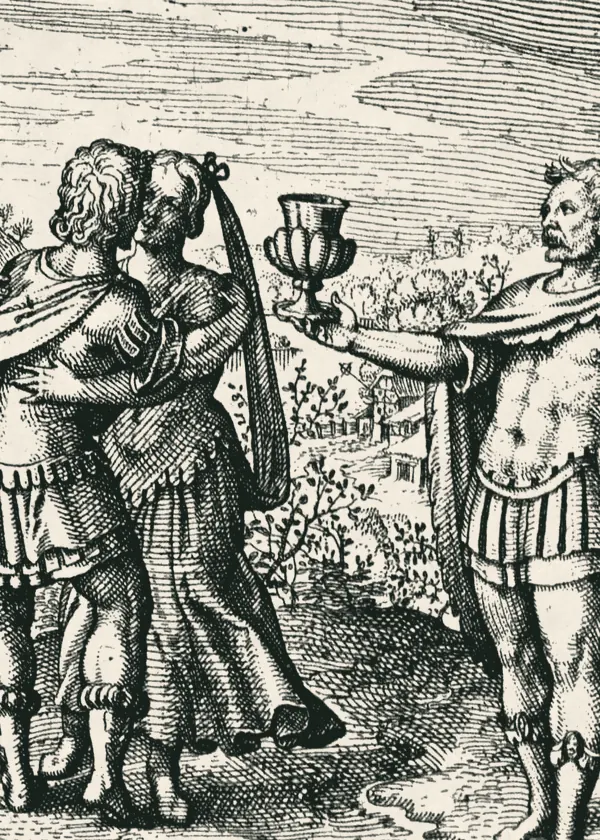
The Lovers are older than their romantic reading: in the Marseille image one figure stands between two others while a Cupid takes aim above. The original motif is choice. The engraving from Maier's “Atalanta fugiens” (1618, Emblem IV) shows a couple in a close embrace while a man hands them a cup — a union consciously sealed. The card speaks of union that grows out of a conscious decision — for a person, a path, a value. It asks whether heart and mind point the same way, and what you choose when you stay true to yourself.
Origins and symbolism
In the Marseille image one figure stands between two others, with a Cupid above. The motif of choice is older than the later reading as a love relationship.
The card image: Emblem IV: join brother and sister (Michael Maier (text); engravings attributed to Matthäus Merian the Elder, 1618). A couple is joined and a cup is offered – a conscious choice for one another.
Question: Which decision would I like to make with an open heart and a clear head?
Step for today: For one choice, write one sentence each: what draws me, what holds me back?
VII · The Chariot
Keywords: Direction · will · progress
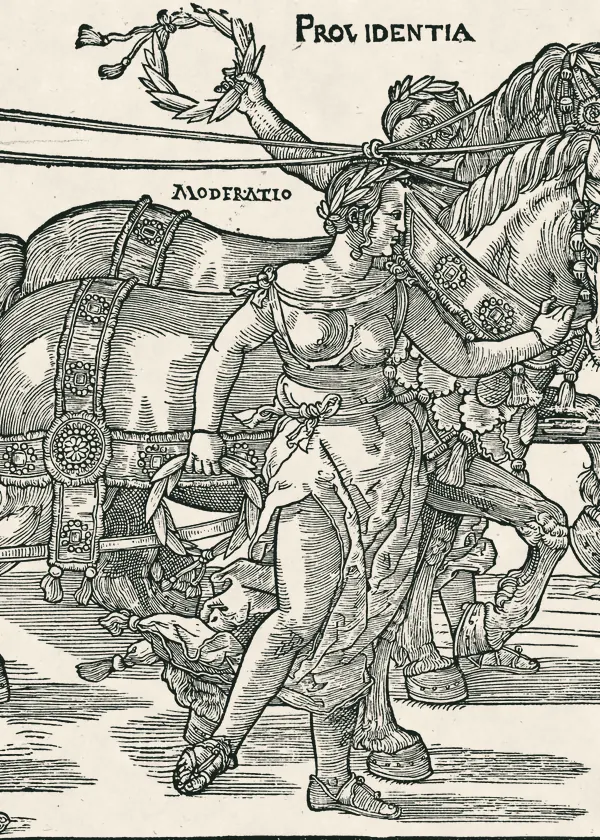
The Chariot shows movement with a goal. On this card Providentia and Moderatio, foresight and moderation, lead the horses by the reins – a sheet from Albrecht Dürer's woodcut “The Great Triumphal Car” for Emperor Maximilian I (1518–1522). The motif comes from Renaissance triumphal processions in which victors rode through the cities. Readings speak of willpower, determination and the art of steering different forces in one direction. It asks where you really want to go and what is pulling you elsewhere right now. Its victory comes not from hardness but from focus: whoever knows where the journey leads arrives even with unruly horses.
Origins and symbolism
“Le Chariot” shows a triumphal car, a motif from Renaissance processions. Readings: direction, will, movement.
The card image: The Great Triumphal Car of Maximilian I, third sheet (Providentia, Moderatio) (Albrecht Dürer, 1518–1522). Providence (Providentia) and Moderation (Moderatio) accompany the horses of the triumphal car – steering different forces one way.
Question: Where do I actually want to go — and what pulls in another direction?
Step for today: Name one goal for this week and cross out one thing that distracts from it.
VIII · Justice
Keywords: Balance · truth · accountability
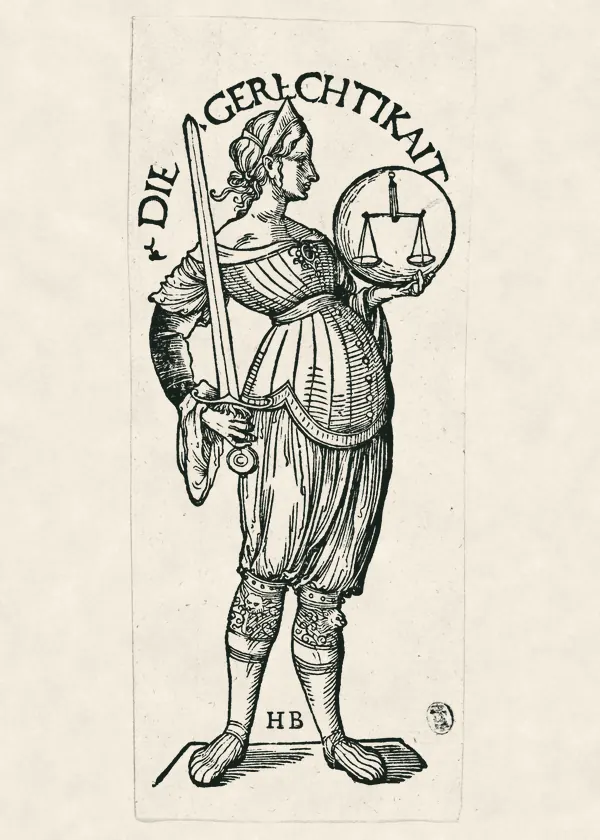
Justice weighs things up. The card shows “Justice” from Hans Burgkmair's series of virtues (c. 1510): an upright figure with a raised sword and the scales in a circle. She is one of the cardinal virtues of the Renaissance sequence; in the Marseille pattern she bears VIII, while the Golden Dawn moved her to XI. The card speaks of clarity, fairness and cause and effect: what you give and do carries weight. It asks where you should look honestly — at an agreement, a decision, your own share. Her justice is not cold but clear: she creates order through truth.
Origins and symbolism
Number VIII in Marseille decks; the Golden Dawn swapped it with Strength to XI. One of the cardinal virtues in the Renaissance sequence.
The card image: Justice, from “The Seven Virtues” (Hans Burgkmair the Elder, c. 1510). Justice with sword and scales – weighing and bearing consequences.
Question: Where would I like to be fairer — to others or to myself?
Step for today: Check one open agreement: does it still feel fair to both sides?
IX · The Hermit
Keywords: Solitude · search · inner guidance
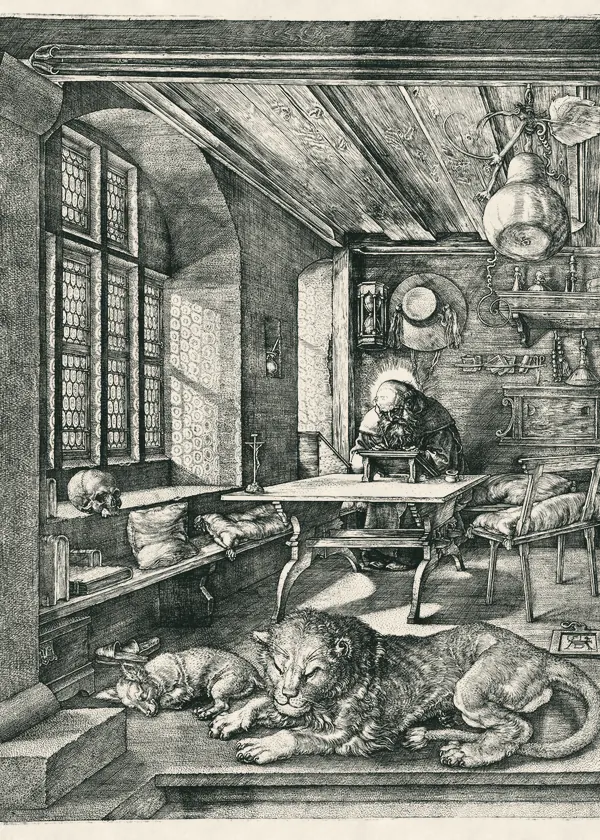
The Hermit walks alone, but not lost. The card shows Albrecht Dürer's engraving “Saint Jerome in His Study” (1514): a scholar works alone in his room, calm light falls through the bullseye panes, and a lion and a dog sleep in front. In early decks he sometimes carried an hourglass and was called Time; later he became the seeker with the lantern. The card speaks of withdrawal, reflection and the wisdom that ripens in silence. It asks which question needs stillness right now in order to be heard. The Hermit does not ask you to know the whole path – only to follow the light you already have.
Origins and symbolism
“L’Hermite” with a lantern; in early decks often Time with an hourglass. Readings: withdrawal, search, contemplation.
The card image: Saint Jerome in His Study (Albrecht Dürer, 1514). A scholar alone in his study in calm light – retreat and reflection.
Question: Which question needs silence for me to really hear it?
Step for today: Take fifteen minutes without a screen and walk or sit alone.
X · The Wheel
Keywords: Change · cycles · turning point
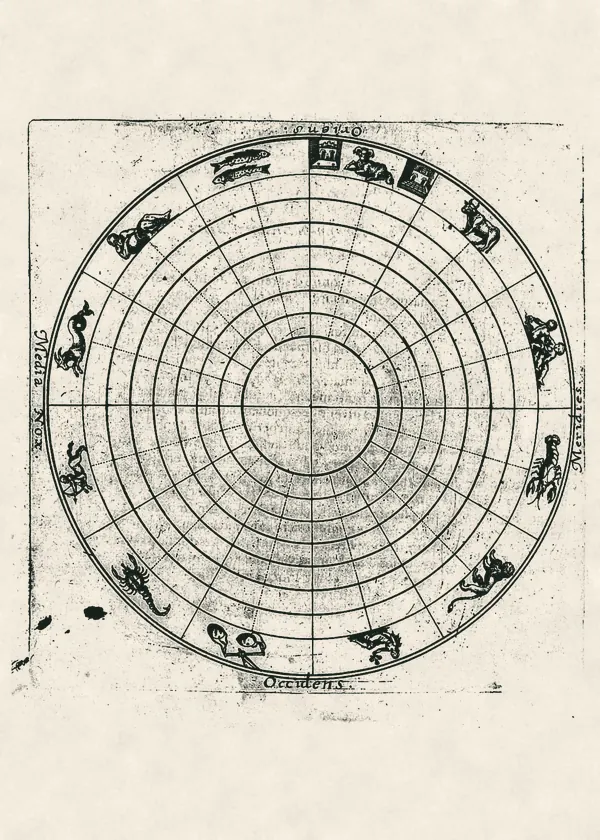
The Wheel turns whether you want it to or not. The card shows an engraving for Robert Fludd's art of memory (1619–1621): the twelve signs of the zodiac around a circle of rings and spokes. The card takes up the medieval wheel of Fortuna that lifts people up and lets them down again — an image for times that change. Readings speak of cycles, turning points and circumstances you do not decide alone. Yet the wheel has a center that does not turn. It asks what stays calm in you while something changes outside, and how you can consciously embrace a new phase instead of clinging to the old one.
Origins and symbolism
“La Roue de Fortune” takes up the medieval wheel of Fortuna showing rise and fall.
The card image: The circle of the zodiac (Ars memoriae) (Robert Fludd (text); engravings from the de Bry workshop, 1619–1621). The wheel of the twelve signs – cycle and the turning of times.
Question: What stays still in me while circumstances turn?
Step for today: Note one change you cannot control and one response to it that you can.
XI · Strength
Keywords: Gentle strength · courage · patience
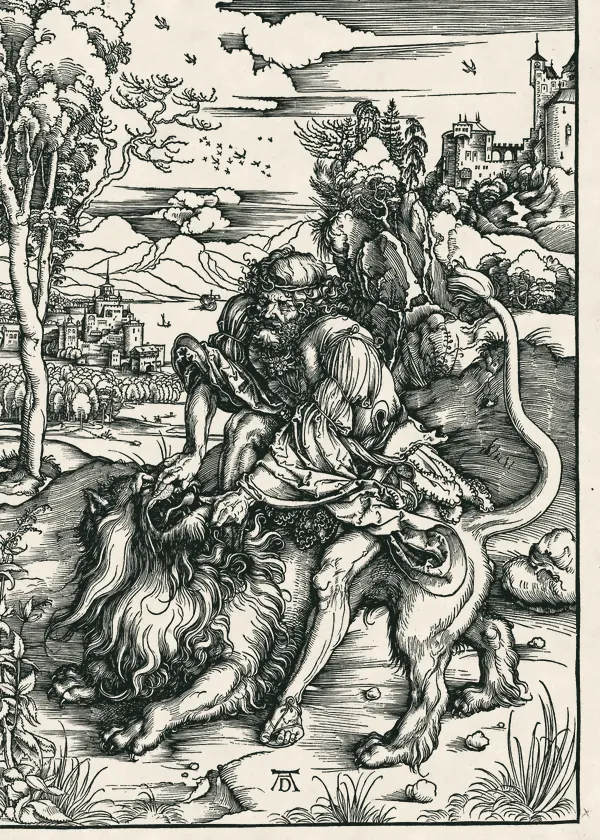
Strength shows power without force. In the Marseille image a woman opens a lion's jaws – not with effort but with calm. Albrecht Dürer's woodcut on this card (c. 1497/98) shows the same gesture as a biblical trial of strength: Samson overcomes the lion and opens its jaws – great force, wholly gathered. The card stands for the cardinal virtue of fortitude; the Golden Dawn placed it at VIII. It speaks of courage, patience and the ability to hold strong feelings without being ruled by them. It asks where kindness achieves more than pressure – with others and with yourself.
Origins and symbolism
In the Marseille image a woman opens a lion's jaws. The cardinal virtue of fortitude; placed at VIII in Golden Dawn decks.
The card image: Samson Rending the Lion (Albrecht Dürer, c. 1497–98). Samson and the lion – strength gathered and directed.
Question: Where does patience help me more than pressure today?
Step for today: Meet an irritable mood — yours or another's — with one slow, friendly sentence.
XII · The Hanged Man
Keywords: Pause · new perspective · surrender
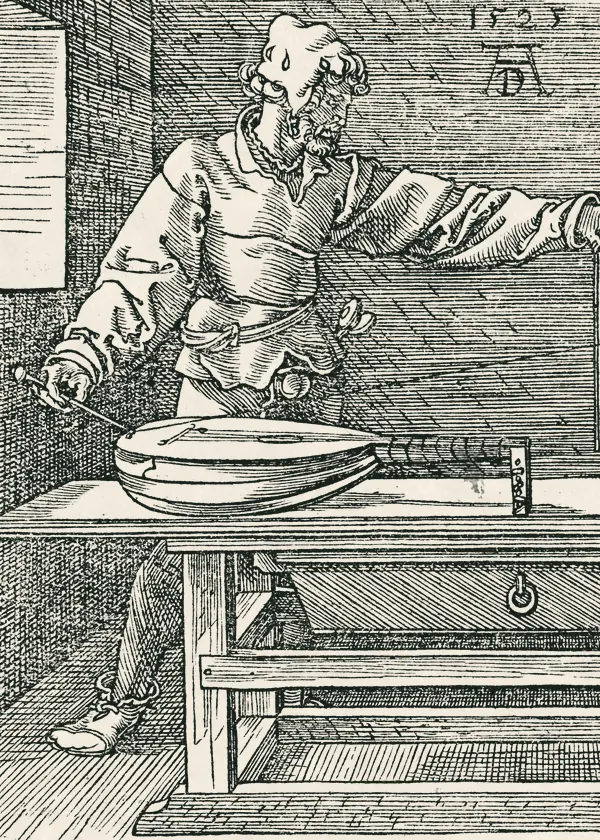
The Hanged Man hangs still and sees the world from the other side. The card shows Albrecht Dürer's “Draughtsman Drawing a Lute” (1525): a man transfers a lute into perspective point by point with a taut thread – seeing from an unfamiliar, fixed point. In fifteenth-century Italy the motif of the hanging man recalled shaming pictures of traitors; later cartomancy turned it into an image of voluntary pause. The card speaks of waiting, letting go and a change of perspective that only becomes possible when you stop pushing. It asks how your situation looks if you view it the other way around. Some things are not solved by doing more, but by seeing differently.
Origins and symbolism
“Le Pendu” hangs by one foot, an image that in fifteenth-century Italy also appeared in shaming pictures of traitors. Later readings: pause, change of perspective.
The card image: The Draughtsman of the Lute (Underweysung der Messung) (Albrecht Dürer, 1525). A draughtsman transfers a lute point by point through a frame – seeing things from another angle.
Question: How would my situation look if I viewed it the other way around?
Step for today: Describe one problem from the point of view of another person involved.
XIII · The Nameless Card
Keywords: Ending · transformation · renewal
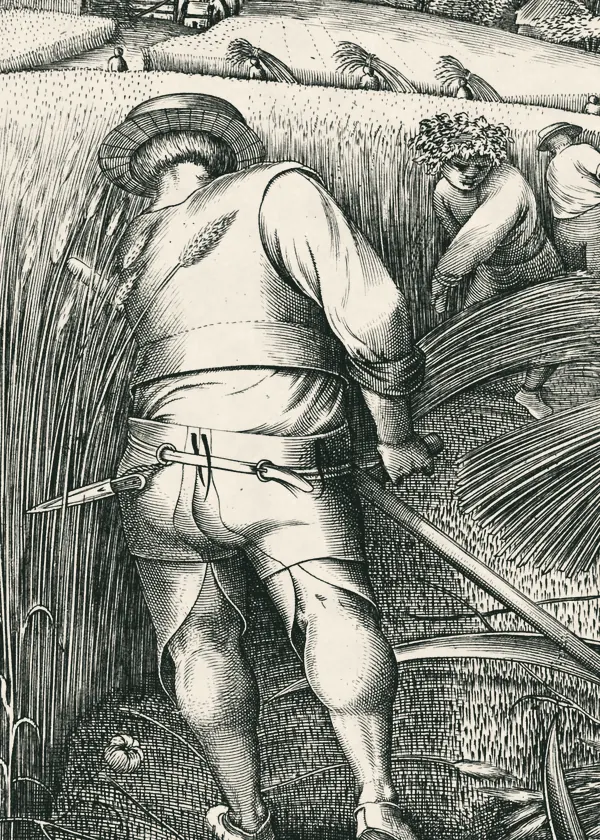
The thirteenth card bears no name in the Marseille pattern; later decks wrote “Death”. In cartomancy it almost always means change and ending, not physical death. The card shows “Summer” from Pieter van der Heyden's engraving after Pieter Bruegel the Elder (1570): a reaper mows the ripe grain — the end of a season as harvest, not as a figure of dread. The card speaks of the end of a chapter, of letting go of what has had its time, and of the room this creates. It asks what may come to an end. Farewells often hurt — yet only they allow something new to truly take root.
Origins and symbolism
In the Marseille pattern XIII bears no name; later decks wrote “Death”. Cartomancy almost always means change and ending, not physical death.
The card image: Summer (Aestas), from “The Seasons”, after Pieter Bruegel the Elder (Pieter van der Heyden, 1570). A reaper mows the ripe grain – the end of a season as harvest, without a frightening image.
Question: What may come to an end so that something new has room?
Step for today: Clear one drawer, folder or list and deliberately let something go.
XIV · Temperance
Keywords: Measure · balance · blending
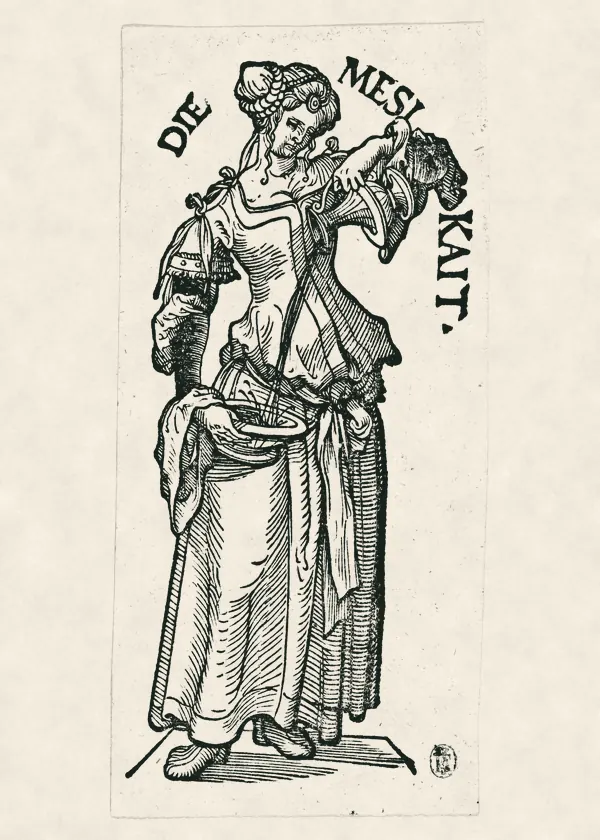
Temperance pours. In the older decks a figure fills water from one jug into the other; on this card Hans Burgkmair's “Temperance” (woodcut, c. 1510) pours from a raised vessel into a bowl. She is the cardinal virtue of measure. The card speaks of balance, patience and the art of blending opposites so that something third emerges. It asks what in your life would like to come into better proportion: work and rest, giving and receiving, fire and water. Her way is not either-or but the right blend.
Origins and symbolism
A figure pours water from one jug into another — the cardinal virtue of measure.
The card image: Temperance, from “The Seven Virtues” (Hans Burgkmair the Elder, c. 1510). Temperance as a calm figure – keeping measure, mixing, balancing.
Question: What would I like to bring into better proportion?
Step for today: Pick one thing you have too much of and one you have too little of, and swap ten minutes.
XV · The Devil
Keywords: Attachment · temptation · shadow
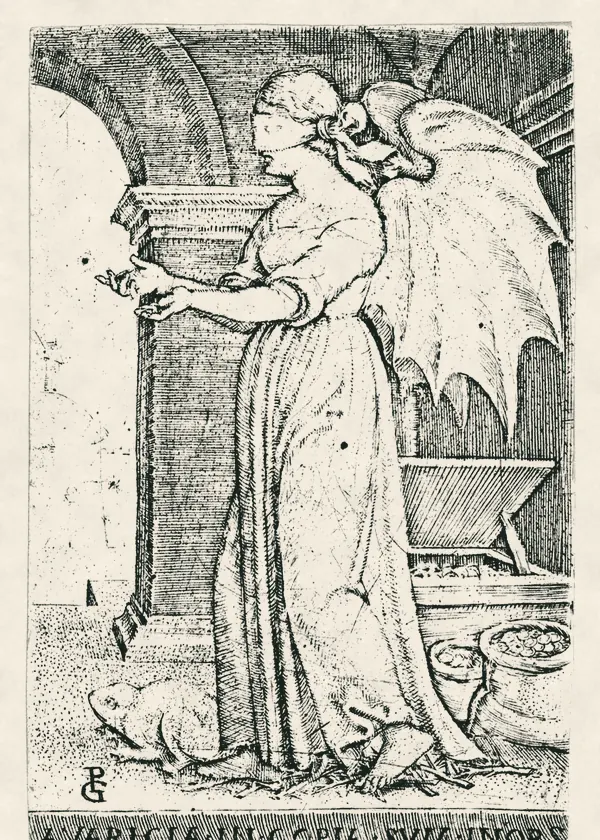
The Devil shows what you are attached to. In the Marseille image he holds two figures on loose cords; this card shows Georg Pencz's “Avarice” (engraving, before 1550): a blindfolded figure with bat's wings reaches for her chest — “poor in her abundance”, says the inscription. The card is an image for recognition, not a threat. It speaks of habits, dependencies, temptations and patterns that hold more power over you than you would like. At the same time it shows vital force, desire and ambition, which only weigh you down when you do not see them. It asks what you are holding on to although the cord has long been loose.
Origins and symbolism
The Marseille Devil holds two figures on loose cords. Readings: attachment, temptation, dependence — an image for recognition, not a threat.
The card image: Avarice (Avaritia), from “The Seven Vices” (Georg Pencz, before 1550). Avarice with bat wings, “poor in plenty” – bound to what one wants to hold on to.
Question: What am I holding on to although the cord has long been loose?
Step for today: Observe one habit for a day without judging it and note when it appears.
XVI · The Tower
Keywords: Upheaval · revelation · release
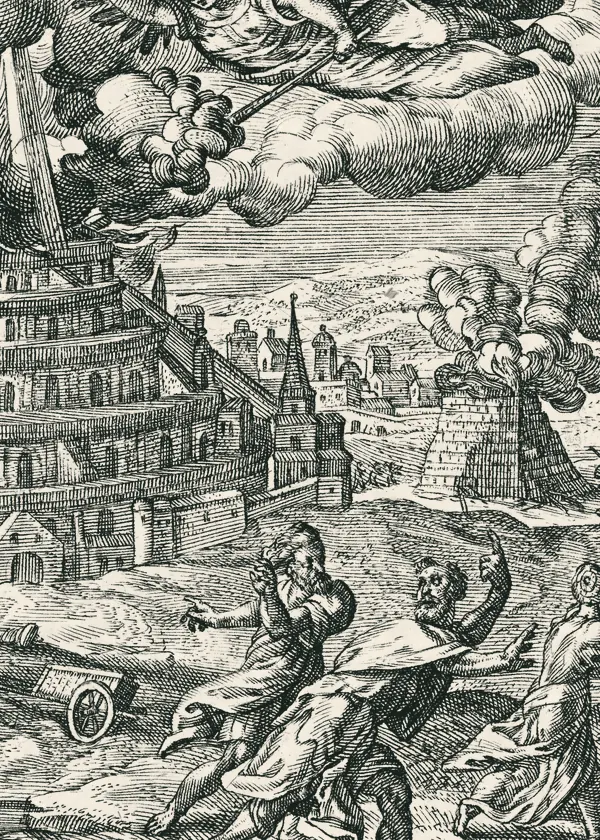
The House of God — “La Maison Dieu” in the Marseille pattern, later “The Tower” — shows the moment when something solid no longer holds. The card shows Crispijn de Passe's engraving “The Destruction of the Tower of Babel” (1612): fire strikes the tower from the clouds and people flee. The card speaks of sudden insight, of certainties that break and of walls that have grown too narrow. Uncomfortable as it seems, later readings also see release in it: what collapses was often built on the wrong ground. It asks which certainty is more fragile than you would like to admit — and what becomes free when you let it go.
Origins and symbolism
“La Maison Dieu”, later “The Tower”. An image of sudden upheaval; later also read as release from rigid forms.
The card image: Destruction of the Tower of Babel (Crispijn de Passe the Elder, 1612). The Tower of Babel burns and people flee – a sudden upheaval.
Question: Which of my certainties is more fragile than I would like to admit?
Step for today: Test one assumption you have not questioned in a long time with one simple counter-question.
XVII · The Star
Keywords: Hope · renewal · trust
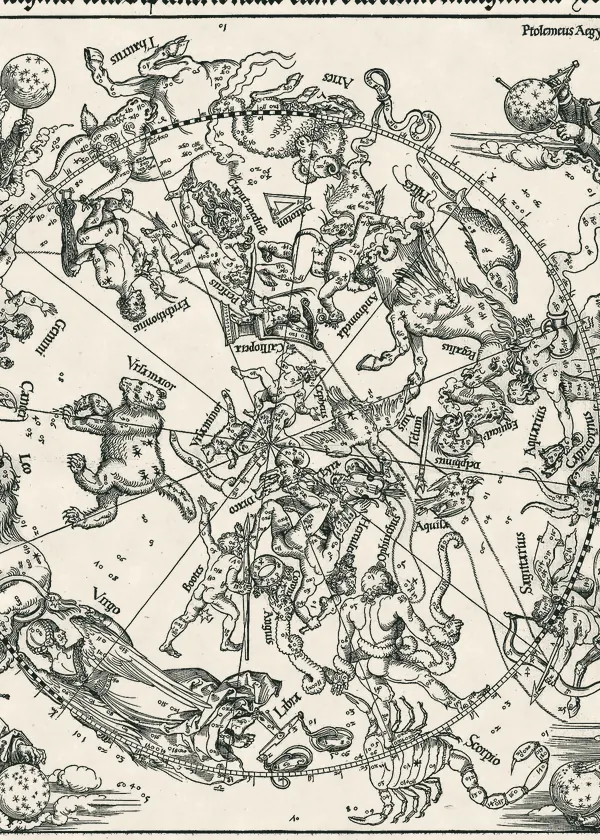
The Star follows the Tower like a clear night after a thunderstorm. In the Marseille image a figure pours out water beneath great stars; this card shows Albrecht Dürer's map of the northern sky (woodcut, 1515), with the constellations by which people find their way at night. The card speaks of hope, renewal and a trust that does not wait for proof. It shows the moment you can breathe again and feel where you belong. It asks what gives you quiet confidence even though nothing is solved yet. Its light is not glaring, but it is enough to see the direction.
Origins and symbolism
“L’Étoile”: a figure pours water beneath great stars. Readings: hope, renewal, trust.
The card image: The Celestial Map – Northern Hemisphere (Albrecht Dürer, 1515). The constellations of the northern sky – finding one's way at night.
Question: What gives me quiet confidence even though nothing is solved yet?
Step for today: Look deliberately at the sky for two minutes this evening.
XVIII · The Moon
Keywords: Uncertainty · dream · intuition
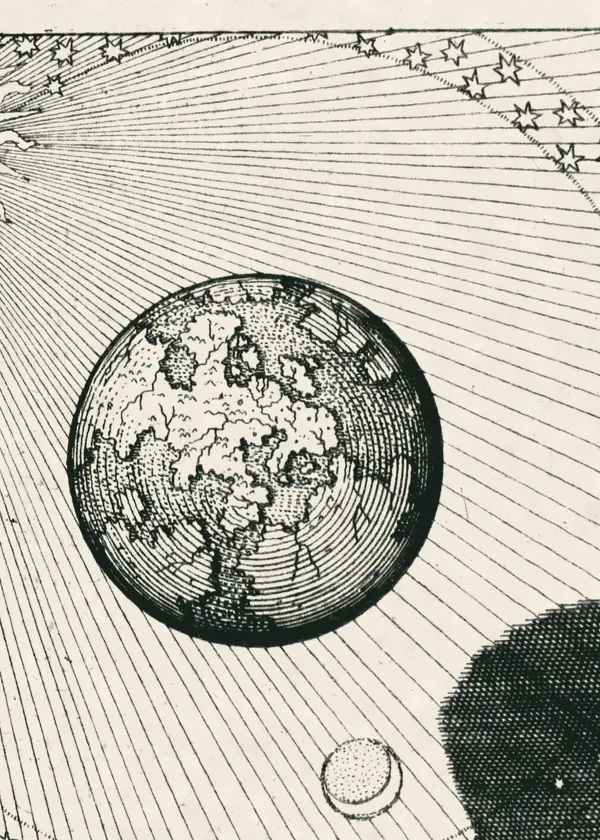
The Moon leads through half-light. In the Marseille image dogs howl between two towers and a crayfish crawls in the water; this card shows, from Maier's “Atalanta fugiens” (1618, Emblem XLV), the Earth in sunlight casting its shadow, with the Moon beside it — the half-light in which images arise. The card speaks of uncertainty, dreams and the world of feelings and images in which not everything is as it seems. It does not warn, it invites: fears and hunches want to be told apart. It asks where you are seeing in half-light right now and what would give you more clarity. Its way is one step after another, without hasty interpretation.
Origins and symbolism
“La Lune” with towers, dogs and a crayfish in water. Readings: uncertainty, dreams, deception and imagination.
The card image: Emblem XLV: the Sun and its shadow complete the work (Michael Maier (text); engravings attributed to Matthäus Merian the Elder, 1618). The Earth casts its shadow in the sunlight – the half-dark in which images arise.
Question: Where am I seeing in half-light right now — and what would give me more clarity?
Step for today: Write down one dream or recurring image without interpreting it straight away.
XIX · The Sun
Keywords: Joy · clarity · vitality
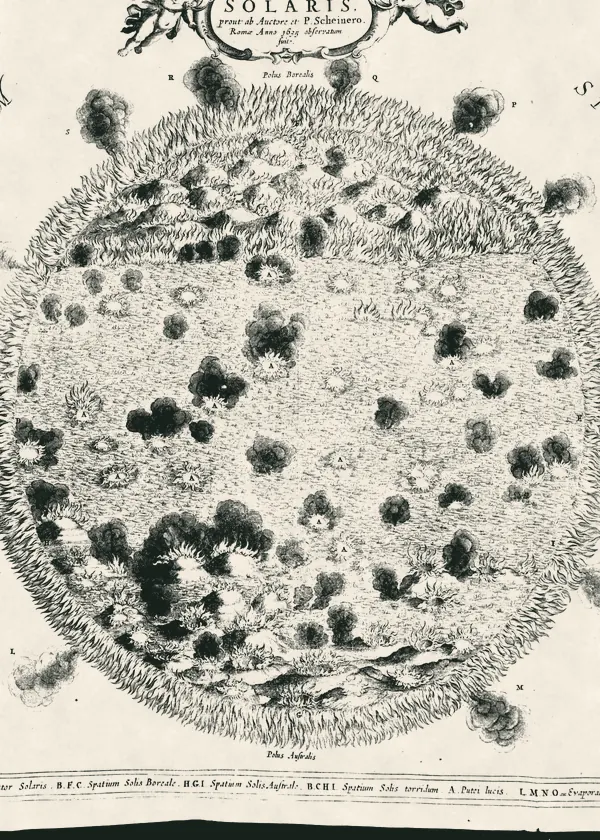
The Sun makes everything visible. In the Marseille image it shines above two children in front of a wall; this card shows Athanasius Kircher's engraving of the body of the Sun after Christoph Scheiner (1665): a globe full of fiery fields and flames. After the half-light of the Moon it brings clarity, warmth and a simple, childlike joy. The card speaks of vitality, of things working out and of relationships in which you may show yourself. It asks what simply makes you glad right now. Its message is light and yet deep: joy is not a luxury but a force that warms others too.
Origins and symbolism
“Le Soleil” above two children before a wall. Readings: clarity, warmth, joy.
The card image: Schema corporis solaris (the body of the Sun) (Athanasius Kircher (after Christoph Scheiner), 1665, edition 1678). Kircher's image of the Sun with its fiery fields – vitality and clarity.
Question: What simply makes me glad right now?
Step for today: Share a small joy with someone today without justifying it.
XX · Judgement
Keywords: Calling · review · rebirth
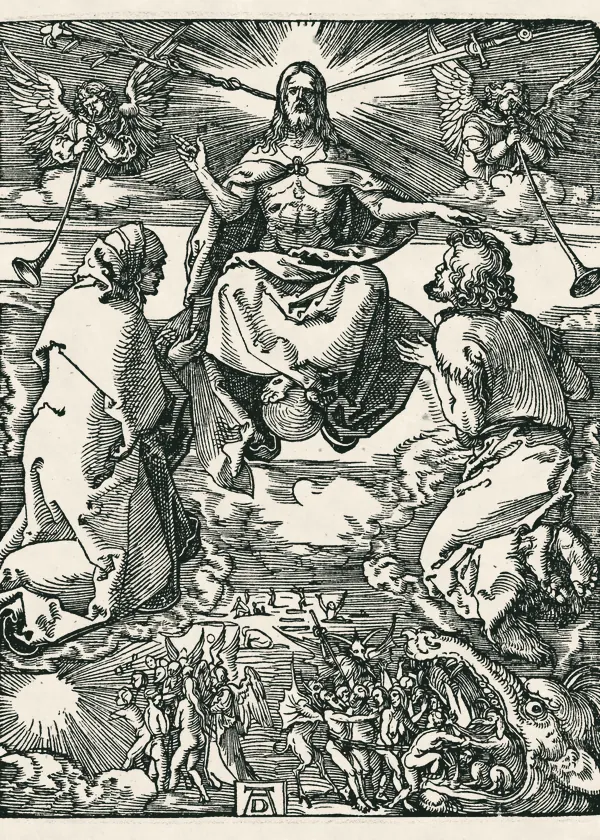
Judgement calls. In the Marseille image an angel sounds a trumpet and figures rise; this card shows Albrecht Dürer's “Last Judgement” from the “Small Passion” (woodcut, c. 1510): angels sound their trumpets, and below, people rise from the earth. Despite the name it is less about a verdict than about awakening: the moment you hear what truly calls you. The card speaks of review, forgiveness and a new beginning that grows out of insight. It asks which call in your life is waiting for an answer. It invites you to look honestly at the past, take along what carries you – and stand up.
Origins and symbolism
“Le Jugement”: an angel sounds a trumpet and figures rise. Readings: calling, review, renewal.
The card image: The Last Judgment, from “The Small Passion” (Albrecht Dürer, c. 1510). Trumpets sound and people rise – a call to wake up and begin anew.
Question: Which call in my life is waiting for an answer?
Step for today: Look back on a finished project: what do you take with you, what do you leave there?
XXI · The World
Keywords: Completion · wholeness · arrival
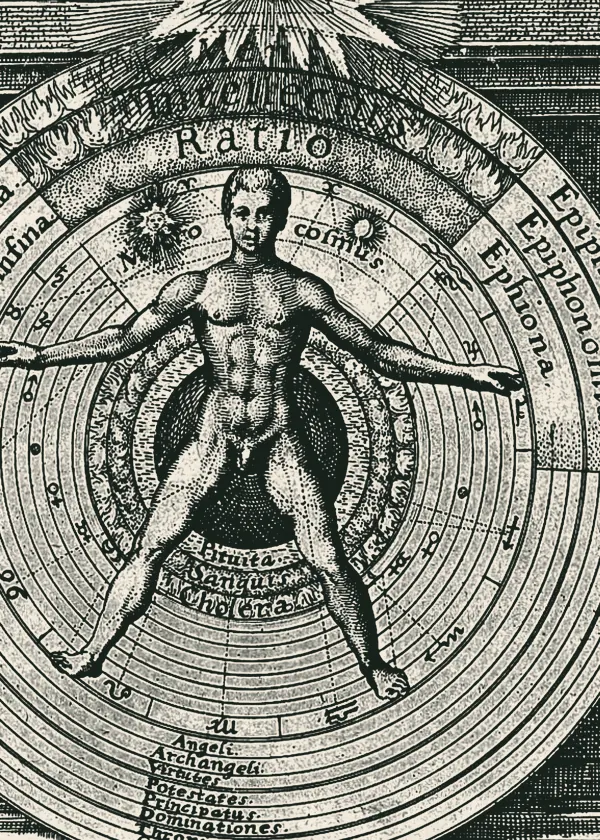
The World closes the series of trumps. In the Marseille image a figure dances in a wreath, surrounded by the four living creatures of evangelist symbolism; this card shows, from Robert Fludd's work (engraving, 1619–1621), the human being with outstretched arms in the rings of the cosmos — the small world within the great one. The card speaks of completion, wholeness and the feeling of having arrived — in a task, a place, in yourself. It asks what in your life has just come full circle and may be celebrated. Every whole is also a new beginning: after the World, the Fool starts again.
Origins and symbolism
“Le Monde”: a figure in a wreath, surrounded by the four living creatures of evangelist symbolism. Readings: completion, wholeness.
The card image: The human being within the circles of the cosmos (title page, Tomus secundus) (Robert Fludd (text); engravings from the de Bry workshop, 1619–1621). The human being within the rings of the world – wholeness and completion.
Question: What in my life has just come full circle — and may be celebrated?
Step for today: Deliberately close one small open loop today and mark it as done.
Frequently asked questions
How many cards does the tarot have?
A full tarot has 78 cards: 22 Major Arcana (trumps) and 56 Minor Arcana in four suits. DESNAVO reads the 22 Major Arcana.
What do reversed tarot cards mean?
People who read reversals usually read the card's shadow side. In DESNAVO the cards lie upright; light and shadow are read together for every card.
Why are Justice and Strength numbered differently?
In the Marseille pattern Justice is VIII and Strength XI. The Golden Dawn and the Rider-Waite deck swapped them. DESNAVO follows the older Marseille numbering.